What HVAC Maintenance Should DeLand Homeowners Do in January and February
Don't let DeLand's mild winters fool you. After servicing thousands of HVAC systems across Volusia County, we can tell you that January and February are when we see some of the most preventable breakdowns of the year. The reason? Homeowners assume their system gets a rest during the cooler months, but those constant swings between 45°F mornings and 75°F afternoons actually force your HVAC to work harder than most people realize.
We've learned that a few targeted HVAC maintenance steps in DeLand during these two months can make the difference between a system that runs efficiently all year and one that fails when summer heat arrives. Here's exactly what your DeLand home needs right now to stay comfortable, protected, and energy-efficient.
TL;DR Quick Answers
What HVAC Maintenance Should DeLand Homeowners Do in January and February?
DeLand's mild winter is the lowest-stress period your HVAC system will face all year. That makes January and February the best window to prepare for Florida's demanding cooling season.
After shipping filters to tens of thousands of Florida homes annually, here's the maintenance sequence we see deliver the best results:
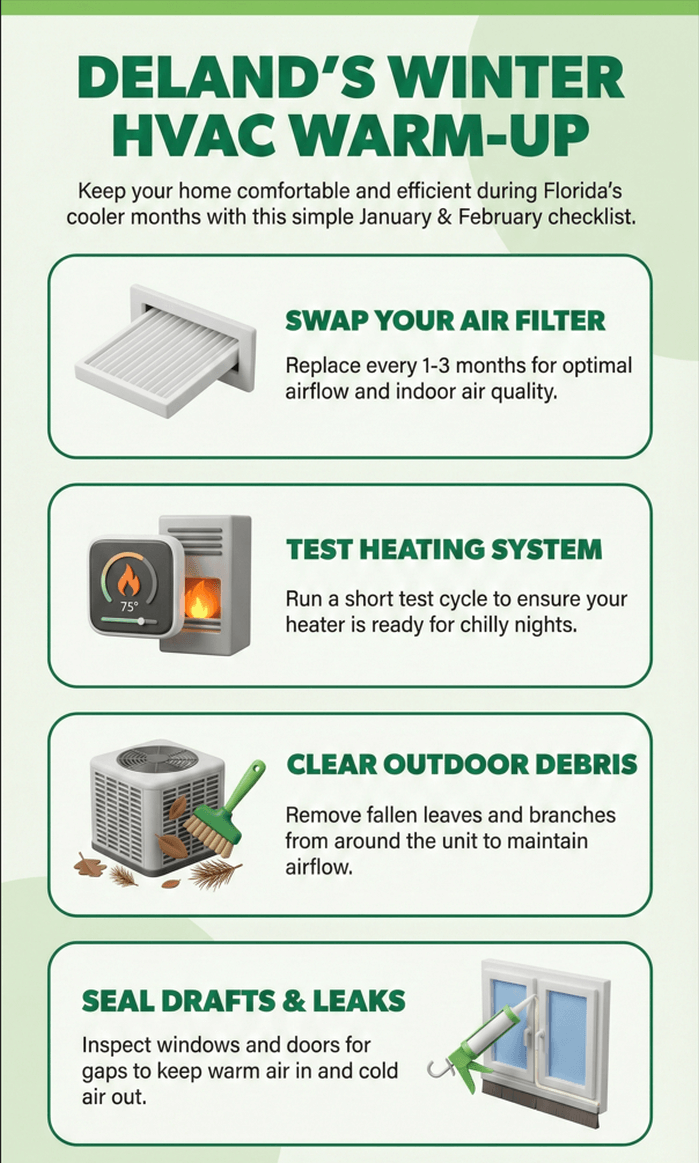
Check and replace your air filter. Winter filters in sealed Central Florida homes load up faster than most homeowners expect. Pull yours out. If you can't see light through it, replace it now.
Schedule a professional tune-up. Contractor availability peaks in January and February. By April, the best technicians are booked through September.
Clear your condensate drain line. Florida's humidity makes this a year-round failure point — not just a summer concern.
Inspect your ductwork for leaks. Up to 30% of conditioned air can be lost through leaky ducts before it reaches your living space.
Complete Duke Energy's free Home Energy Check. DeLand homeowners qualify for up to $3,800 in rebates for efficiency upgrades.
Verify your contractor's license. Sixty seconds on Florida's DBPR portal at myfloridalicense.com confirms credentials and protects your warranty.
Bottom line: The homeowners who avoid emergency HVAC calls in summer are almost always the ones who handled maintenance in January or February.
Top Takeaways
January and February are your best maintenance windows all year. DeLand's mild winter puts the least stress on your system. You get first pick of qualified contractors — before the April–September rush drives up wait times and pricing.
Your indoor air is likely worse than you think.
The EPA reports indoor air can be 2–5× more polluted than outdoor air.
Homes sealed against cooler temperatures trap and recirculate those pollutants.
If your filter has been in place since the holidays, it's carrying a heavier load than most homeowners realize.
A new filter alone won't fix a neglected system. Filters only perform when three conditions are met:
Airflow is unobstructed
Ducts are properly sealed
The mechanical system behind them is sound
Nearly half of your home's energy goes to heating and cooling. Up to 30% of that can be lost through leaky ductwork before it ever reaches your living space.
Free resources and rebates are available right now.
Duke Energy offers DeLand homeowners a free Home Energy Check — with up to $3,800 in rebates.
ENERGY STAR, the DOE, and the EPA publish free maintenance checklists and energy-saving guides.
Use them before scheduling any service call.
Verify before you hire. Florida's DBPR license portal confirms any HVAC contractor's credentials in under 60 seconds. A licensed, insured technician protects your equipment warranty, your home, and your investment.
Check and Replace Your Air Filters
It is the one and the most effective thing that you can do in your HVAC system at the moment. In the winter months of Florida, the DeLand system turns on and off more often than you think, and when it is dirty, it is obliged to toil overtime with each change. We suggest that you test your filter after every 30 days in the months of January and February, particularly when you have pets or family members who are allergic. A clean and high-quality pleated filter with MERV 8 or more ensures a constant flow of air, and your system remains in a working mode when it should change gears between modes.
Schedule a Professional Winter Tune-Up
The majority of the DeLand homes fix their HVAC systems in the pre-summer season, yet January and February are, in fact, the best months to get a technician to check your system. The needs are minimal, the time schedule can be organized and any problems are resolved long before the scorching heat hits. During such months a professional tune-up is normally done and this may involve checking the refrigerant level, electrical connection, cleaning the condensate drain line and ensuring that both your heating and cooling processes are going on smoothly. Consider it a jump start to the year ahead of your system.
Test Your Thermostat Settings
The temperature oscillations in Winter in DeLand are causing your thermostat to work harder than normal. Allow some couple of minutes to ensure that it is up to the mark by putting the display of the thermometer side by side with another thermometer available. In case you have a programmable or smart thermostat you can adjust your schedule according to the seasonal pattern. When you are at home on colder mornings, we usually recommend turning it to 68F and letting it regulate itself in the afternoon as the temperature increases instead of turning it off during the day. Stable environments save on wear of your system and save on energy expenses.
Clear the Area Around Your Outdoor Unit
Central Florida's winter growing season means vegetation doesn't stop just because temperatures dip. Walk outside and check your outdoor condenser unit for encroaching shrubs, fallen leaves, pine needles, or debris that may have accumulated. We recommend maintaining at least two feet of clearance on all sides to ensure proper airflow. A quick visual inspection once a month during January and February takes just a few minutes and can prevent restricted airflow that leads to reduced efficiency or compressor strain.
Inspect Your Ductwork for Leaks
Leaky ducts are one of the most common issues we find in DeLand homes, particularly in older construction throughout the downtown and historic districts. When your system switches between heating and cooling, those temperature changes can cause duct joints to expand and contract, loosening connections over time. Check any visible ductwork in your attic, garage, or crawl space for gaps, disconnected sections, or damaged insulation. Sealing even small leaks can improve your system's efficiency by up to 20 percent, which translates directly to lower utility bills.
Monitor Your Indoor Humidity Levels
Even during the cooler months, DeLand's humidity rarely drops to the levels you'd find further north. Indoor humidity that creeps above 50 percent creates an environment where mold and mildew thrive, particularly in areas with limited ventilation like bathrooms, closets, and laundry rooms. Your HVAC system plays a key role in managing moisture levels, so if you notice condensation on windows or a musty smell in certain rooms, it may indicate your system isn't dehumidifying properly. A simple hygrometer can help you keep tabs on indoor moisture so you can address issues before they become costly problems.
Don't Overlook Your Carbon Monoxide Detectors
If your DeLand home uses a gas furnace or heat pump with auxiliary heating, January and February are critical months to verify your carbon monoxide detectors are functioning properly. Test each unit, replace batteries if needed, and make sure you have detectors installed near sleeping areas and on every level of your home. This is a quick safety check that takes less than five minutes but provides essential peace of mind during the months when heating components are most active.
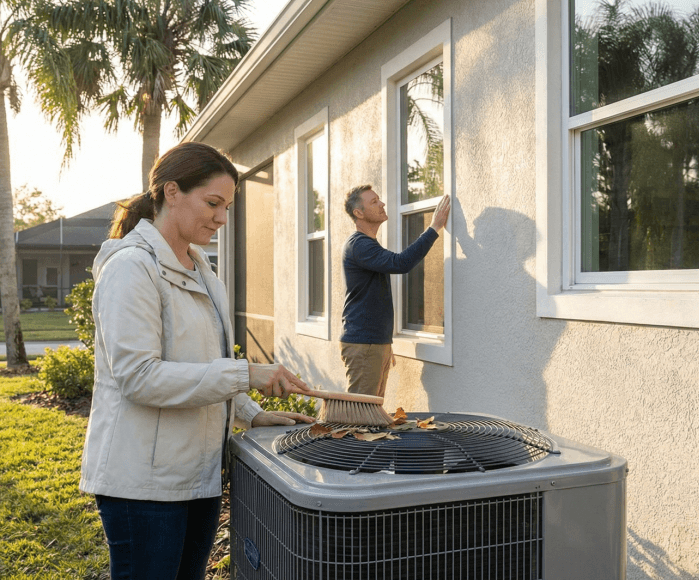
"After servicing HVAC systems across DeLand for years, we've found that the homeowners who invest just 30 minutes in basic maintenance during January and February rarely end up calling us for emergency repairs when summer hits."
7 Essential Resources Every DeLand Homeowner Needs for January and February HVAC Maintenance
Don't take your indoor air for granted — especially during DeLand's coolest months when your home is sealed up tight, and your HVAC system is working differently than the rest of the year. At FilterBuy, we're obsessed with helping you protect your greatest assets: your family, your home, and your HVAC system. These seven trusted resources put you in control of smarter maintenance decisions before summer demand hits.
Verify Exactly What a Professional HVAC Tune-Up Should Include
Source: ENERGY STAR – HVAC Maintenance Checklist
URL: https://www.energystar.gov/saveathome/heating-cooling/maintenance-checklist
Not all tune-ups are created equal. This government-backed checklist breaks down every task a qualified contractor should perform — from checking refrigerant levels to cleaning coils. Use it as your playbook to make sure you're getting thorough service, not just a quick once-over.
Pro Tip: Print this checklist before your next service call. You'll know exactly what to expect and what questions to ask.
Get the Most Out of Your Heat Pump During DeLand's Cooler Months
Source: U.S. Department of Energy – Operating and Maintaining Your Heat Pump
URL: https://www.energy.gov/energysaver/operating-and-maintaining-your-heat-pump
Here's something most DeLand homeowners don't realize: setting back your heat pump thermostat in January can actually trigger expensive backup electric resistance heating — costing you more, not less. This DOE guide covers the operational details that make a real difference in your winter energy bills, including fan settings and filter change timing.
Pro Tip: A neglected heat pump can consume up to 25% more energy than a well-maintained one. That's money leaving your home every month.
Cut Your Winter Energy Bills With Proven Low-Cost Strategies
Source: U.S. Department of Energy – Fall and Winter Energy-Saving Tips
URL: https://www.energy.gov/energysaver/fall-and-winter-energy-saving-tips
You don't need expensive upgrades to lower your January and February energy costs. This DOE resource delivers practical, no-cost and low-cost strategies — from smart thermostat habits to simple weatherization fixes — that DeLand homeowners can start using today.
Pro Tip: Setting your thermostat back 7–10 degrees for eight hours a day can save up to 10% annually on heating and cooling. Small changes add up fast.
Protect Your Family From Hidden Indoor Air Pollutants
Source: U.S. EPA – Protect Indoor Air Quality in Your Home
URL: https://www.epa.gov/indoor-air-quality-iaq/protect-indoor-air-quality-your-home
Here's what might surprise you: the air inside your DeLand home can be 2 to 5 times more polluted than the air outside — and that problem gets worse in January and February when windows stay closed. The EPA's guide walks you through source control, ventilation, and the role your HVAC filter plays in keeping your family breathing cleaner air.
Pro Tip: Your air filter is your home's first line of defense. A clean, properly rated filter traps the dust, allergens, and particles you can't see before they circulate through every room.
Unlock Free Energy Assessments and Up to $3,800 in HVAC Rebates
Source: Duke Energy Florida – Home Energy Check and Savings Programs
DeLand homeowners served by Duke Energy Florida can schedule a free Home Energy Check and qualify for up to $3,800 in rebates on HVAC upgrades, duct sealing, and attic insulation. January and February are the smartest times to take advantage — before summer creates long wait times for both contractors and utility programs.
Pro Tip: Complete the free online energy assessment first. It takes 5–10 minutes and immediately shows whether you qualify for rebates that offset major upgrade costs.
Confirm Your HVAC Contractor Is Properly Licensed in Florida
Source: Florida DBPR – License Verification Portal
URL: https://www.myfloridalicense.com
Before any contractor touches your system, take 60 seconds to verify their license. Florida requires all HVAC contractors to hold valid credentials through the Department of Business and Professional Regulation. Unlicensed work can void your manufacturer's warranty, fail inspections, and leave you holding the bill if something goes wrong.
Pro Tip: A reputable contractor will display their license number on their truck, website, and estimates. If someone won't provide it — that's your answer.
Understand the National Standard for Quality HVAC Maintenance
Source: ACCA – Quality Maintenance of Residential HVAC Systems (Standard 4)
URL: https://www.acca.org/viewdocument/quality-maintenance-of-residential-hvac-systems
The ANSI/ACCA 4 QM standard is the industry's nationally recognized benchmark for what a residential HVAC maintenance inspection should include. When comparing service plans from different DeLand contractors, this standard helps you separate thorough maintenance from a basic filter swap marketed as a "tune-up."
Pro Tip: Ask your contractor if their maintenance program meets ACCA Standard 4 requirements. Their answer tells you a lot about the quality of service you'll receive.
Supporting Statistics: Why January and February HVAC Maintenance Matters for DeLand Homeowners
After manufacturing air filters for over a decade and working with millions of customers, we've seen firsthand how these federal statistics match what DeLand homeowners actually experience. The maintenance decisions you make during the cooler months have an outsized impact on your comfort, your air quality, and your wallet.
Nearly Half of Your Home's Energy Goes to Heating and Cooling
According to ENERGY STAR, nearly 50% of the energy used in an average American home goes directly to heating and cooling.
We see this play out in our Florida customers' ordering patterns every year. DeLand homeowners tend to focus on maintenance right before summer — but the families who stay ahead during January and February consistently report lower costs when peak cooling season arrives.
Here's why early maintenance compounds:
A system with clean filters doesn't strain to push air through clogged media
Sealed ducts stop wasting conditioned air before summer demand spikes
Properly maintained components run more efficiently from day one of the cooling season
That head start compounds across every billing cycle through October
Source: ENERGY STAR – Heat & Cool Efficiently
https://www.energystar.gov/saveathome/heating-cooling
Indoor Air Can Be 2 to 5 Times More Polluted Than Outdoor Air
EPA studies consistently show indoor pollutant concentrations are 2 to 5 times higher than outdoor levels — and in some cases, more than 100 times higher.
This is something we think about constantly at FilterBuy. Your air filter is the one component standing between those pollutants and your family's lungs.
What most DeLand homeowners don't realize is that January and February actually increase this risk:
Homes stay closed against cooler temperatures
Humidity drops and airborne particles recirculate without dilution
Pollutants concentrate faster in sealed indoor environments
A filter in place for 90 days during winter captures significantly more particulate than most homeowners expect
If you haven't checked your filter since the holidays, now is the time.
Source: U.S. EPA – Report on the Environment: Indoor Air Quality
https://www.epa.gov/report-environment/indoor-air-quality
Leaky Ducts Waste Up to 20–30% of Your Conditioned Air.
ENERGY STAR reports that roughly 20 to 30 percent of air moving through a typical home's duct system is lost to leaks, holes, and poor connections.
Here's why that matters more than most people think — even a perfectly rated filter can't protect air that never passes through it.
When conditioned air escapes through duct gaps in DeLand-area homes, two things happen:
You lose air you've already paid to condition. Heated or cooled air escapes into unconditioned attic spaces and never reaches your living areas.
Unfiltered air gets pulled in. Duct leaks draw in attic dust, insulation particles, and outdoor contaminants that bypass your filter entirely.
January and February are the smartest times to address this:
Contractor availability is higher before peak summer demand for HVAC service
Your system isn't under a heavy cooling load during inspection
Sealing now means every dollar spent on conditioned air this summer actually reaches your family
Source: ENERGY STAR – Heat & Cool Efficiently
https://www.energystar.gov/saveathome/heating-cooling
Final Thought: What We've Learned After a Decade of Helping DeLand Homeowners Breathe Better
Most HVAC maintenance advice treats January and February as an afterthought — a quiet gap between heating season up north and cooling season down south.
After manufacturing millions of air filters and working directly with Central Florida homeowners, we see it differently.
January and February are the highest-leverage maintenance windows DeLand homeowners have all year.
Why These Two Months Matter More Than You Think
Your system is under minimal stress. DeLand's mild winter means no extreme demand in either direction. Safest time to inspect, service, and correct issues.
Contractor availability peaks now. Every Volusia County HVAC pro gets slammed from April through September. Schedule now — get first pick of qualified technicians.
Small problems stay small. A worn capacitor in February is a minor repair. That same issue in August becomes an emergency call at emergency pricing.
Your filter carried a heavier load than expected. Sealed homes recirculate pollutants without dilution. We see it consistently — winter filters come out dirtier than homeowners anticipate, regardless of MERV rating.
Our Honest Take
We built FilterBuy around one belief: clean air isn't optional.
But here's something most companies in our space won't say:
A new filter alone won't fix a neglected system.
Filters perform when three conditions are met:
Airflow is unobstructed
Ducts are properly sealed
The mechanical system behind them is sound
That's why this page goes beyond filter changes. It connects you with:
Government-backed maintenance checklists
Your local utility's free energy programs
Contractor licensing verification
National maintenance standards
The goal: every tool you need to make a fully informed decision — not just a product pitch.
What Works: The Five-Step Sequence We See Winning Year After Year
Check and replace your air filter now. Don't wait for spring.
Schedule a professional tune-up this month. Availability is high. Pricing is fair.
Complete Duke Energy's free Home Energy Check. Rebates alone can offset major upgrade costs.
Verify your contractor's license first. Sixty seconds on the DBPR portal protects your warranty and your investment.
Seal your ducts before summer. Every dollar of conditioned air should reach your living space — not your attic.
That's not theory. That's what we've observed working with real families in real Florida homes over more than a decade.
Your home is your family's single biggest investment. January and February are your best window to protect it.
Frequently Asked Questions:
Q: Why is January or February the best time for HVAC maintenance in DeLand?
A: We ship filters to tens of thousands of Florida homes every year. The pattern never changes. Orders spike in summer when systems fail, and homeowners scramble. By then, the damage is already done.
January and February give DeLand homeowners two advantages that no other months match:
Your system is under minimal stress. DeLand's mild winter means no extreme demand in either direction. A technician can inspect and service every component without risking a comfort emergency.
You get first pick of the best contractors. Every Volusia County HVAC pro gets booked solid from April through September. Scheduling now means qualified technicians at fair pricing.
Here's what we've learned working directly with Central Florida homeowners:
The families who avoid summer emergencies are almost always the ones who scheduled maintenance in January or February.
A worn capacitor found now is a minor repair.
That same issue in August — with your system running 12+ hours a day — becomes an emergency call at emergency pricing.
Q: How often should I change my air filter during DeLand's winter months?
A: Every 30 days. No exceptions.
Here's why that surprises most homeowners.
We manufacture filters across every standard MERV rating. We also test the filters returned through our subscription program. What we consistently find: winter filters pulled from sealed Central Florida homes carry a heavier particulate load than homeowners expect.
The reason is simple:
Your home is closed up against cooler nighttime air.
Your system recirculates the same pollutants — dust, pet dander, cooking particles, mold spores.
No open windows means no dilution.
Your system may run fewer hours than in July. But the air it cycles is more concentrated.
Factors that shorten filter life even further:
Pets — replace every 30 to 60 days. Pet dander is one of the fastest filter-loading contaminants we see across MERV ratings.
Allergies or asthma in the household — replace every 30 to 45 days. A loaded filter can't capture what it's already holding.
Higher MERV-rated filters — they trap finer particles and reach capacity sooner. That's a feature, not a flaw — but it requires more frequent replacement.
Quick test: Pull your filter out. Hold it up to a light source. If you can't see light through it, it's done. Don't wait for your calendar reminder.
Q: What should a professional HVAC tune-up include for a DeLand home?
A: Most DeLand homes run heat pump systems — not separate AC units and furnaces.
That's a detail many generic maintenance guides miss. A heat pump handles both heating and cooling through the same components. Both sides need attention, even in Florida's mild winter.
After years of working alongside HVAC professionals and hearing directly from homeowners about what was — and wasn't — covered, here's what a thorough DeLand tune-up should include:
Inspect and clean evaporator and condenser coils
Check refrigerant levels and test for leaks
Test electrical connections, capacitors, and contactors
Lubricate moving parts to prevent premature wear
Clear the condensate drain line — Florida's year-round humidity makes this a top failure point we hear about repeatedly
Calibrate the thermostat for accuracy
Inspect ductwork for visible leaks or disconnections
Evaluate the air filter and recommend the right replacement schedule for your home's specific conditions
Pro Tip: Ask your contractor if their program meets ACCA Standard 4 requirements. This is the national benchmark for quality residential HVAC maintenance. In our experience, the contractors who follow it deliver noticeably better outcomes. Not every company meets this standard. The ones that do are worth finding.
Q: Are there rebates or free programs available to DeLand homeowners for HVAC maintenance or upgrades?
A: Yes. This is one of the most underused advantages DeLand homeowners have.
We talk to Florida homeowners every day who spend hundreds on HVAC service — without realizing their own utility company offers free assessments and significant rebates.
Duke Energy is DeLand's electric utility provider. Their free Home Energy Check includes:
A no-cost online energy assessment of your home
Personalized efficiency improvement recommendations
Up to $3,800 in rebates for qualifying upgrades — high-efficiency HVAC equipment, duct sealing, and insulation
Federal agencies also publish free resources to help you walk into any contractor visit better informed:
ENERGY STAR — printable HVAC maintenance checklist you can hand directly to your technician
U.S. Department of Energy — seasonal energy-saving guides with tips for mild-winter climates
EPA — indoor air quality protection guides written for homeowners
We point customers to these resources constantly. An informed homeowner makes better decisions about their entire system — including filtration.
Recommended order:
Complete the free Duke Energy assessment first.
Review the ENERGY STAR maintenance checklist.
Then schedule your service call.
The rebates alone can offset costs that most homeowners assumed they'd pay out of pocket.
Q: How do I verify that an HVAC contractor in DeLand is properly licensed?
A: This question comes up more than people expect — and usually after something has already gone wrong.
As a manufacturer, we see the downstream effects of unlicensed work regularly. Homeowners contact us about:
Airflow problems
Filter fit issues
Systems that can't maintain temperature
When we dig into the details, the root cause often traces back to unqualified work:
Ductwork connected incorrectly
Filter housings that don't seal
Return air paths that bypass filtration entirely
How to verify in under 60 seconds:
Florida requires all HVAC contractors to hold a state license. Check credentials at the Florida DBPR portal: myfloridalicense.com.
Look for three things:
License status — current and active, not expired or revoked
License type — must be a Certified or Registered Mechanical Contractor
Insurance coverage — liability insurance and workers' compensation
Pro Tip: A reputable contractor displays their license number on their website, truck, and business card without being asked. If you have to request it, that's a red flag.
What's at stake:
An unlicensed contractor can void your equipment manufacturer's warranty.
You could be liable for on-site injuries.
Work may not meet the Florida building code.
Sixty seconds of verification protects your home, your warranty, and your investment.
DeLand Homeowners: Start Your January and February HVAC Maintenance With the Right Filter
Your air filter is the first component in your system that determines whether the air your family breathes is clean — and whether your HVAC runs efficiently through Florida's longest, hardest season. Find your exact filter size now and get it delivered straight to your door before your next maintenance visit.
Learn more about HVAC Care from one of our HVAC solutions branches…
Filterbuy HVAC Solutions - Miami, FL - Air Conditioning Service
1300 S Miami Ave Apt 4806 Miami, FL 33130
(305) 306-5027
https://maps.app.goo.gl/Ci1vrL596LhvXKU79